
What Is Provably Fair Gaming? How Crypto Casinos Prove Their Games Are Fair
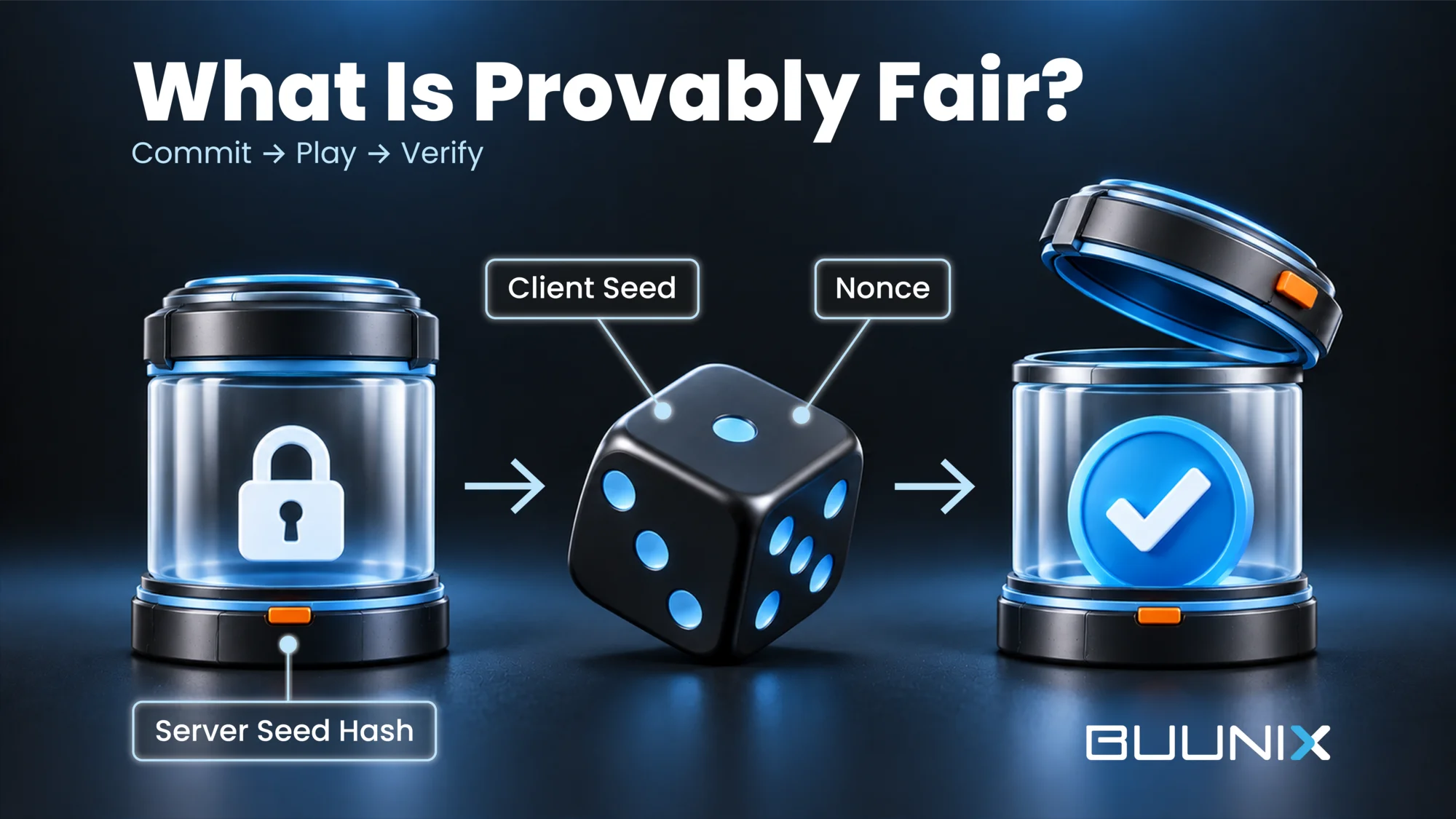
When you play a traditional online casino game, you normally have to trust that its random number generator works as advertised. Provably fair gaming changes that relationship: it gives players cryptographic data they can use to independently verify that a game result was not changed after the bet was placed.
This system is particularly common in crypto gambling. Provably fair crypto casinos can publish cryptographic commitments before a round and reveal the underlying data afterward, allowing players to check the result themselves.
But “provably fair” is easy to misunderstand. It does not mean you are more likely to win, and it does not automatically make a casino trustworthy in every other respect. Here’s what the technology actually proves.
What Is Provably Fair?
Provably fair is a cryptographic system that lets players verify that an online casino did not alter a game’s predetermined inputs after a bet was made. Instead of asking players to simply trust the operator, the system provides mathematical evidence they can independently check.
Most implementations rely on three inputs:
- Server seed: secret data generated by the casino.
- Client seed: data supplied or generated on the player’s side.
- Nonce: a counter that changes with each bet.
A cryptographic hash is used to commit the casino to its server seed before the result is revealed. NIST defines cryptographic hashing as producing a fixed-length output with properties designed to make reversing the process or finding matching inputs computationally infeasible.
That matters because the casino cannot quietly replace its committed seed later without producing a different hash.
Provably Fair Meaning in Simple Terms
The easiest way to understand provably fair meaning is to think of the hash as a sealed digital commitment.
Imagine the casino writes a secret number on a piece of paper, locks it inside a transparent safe, and lets you inspect the lock before you bet. You cannot see the number yet, but the casino cannot replace it without breaking the seal.
After the round, the safe opens. You can compare what was inside with the commitment you saw beforehand.
Cryptographic hashes perform a similar role mathematically.
| Stage | What the casino/player sees | Why it matters |
|---|---|---|
| Before the bet | Hashed server seed | Casino commits to its secret input |
| During play | Client seed + nonce participate in result generation | Outcome depends on defined inputs |
| After seed rotation/reveal | Original server seed becomes available | Player can hash it independently |
| Verification | Calculated hash is compared with the original | A mismatch exposes altered data |
How Does a Provably Fair Crypto Casino Work?
A provably fair crypto casino typically commits to a hidden server seed, combines it with player-side data and a nonce, and uses a defined algorithm to derive game results. Once the relevant seed is revealed, the player can reproduce the verification process and check whether the original commitment matches.
The exact implementation varies between casinos and games, but the basic process looks like this:
- The casino generates a random server seed.
- It creates a cryptographic hash of that seed.
- The hash is shown to the player before betting.
- A client seed is generated or selected.
- Each wager receives a nonce.
- The game’s algorithm combines those values to calculate an outcome.
- The casino later reveals the original server seed.
- The player verifies the seed against the earlier hash and, where supported, recalculates the result.
This commitment-and-reveal structure is the core of provable fairness. As Webopedia’s explanation of provably fair gaming notes, changing the original server seed would also change its hash, making the modification detectable.
Server Seed, Client Seed, and Nonce Explained
These three values do different jobs. Treating all of them as simply “random numbers” misses an important part of how the system works.
| Component | Usually controlled by | Function |
|---|---|---|
| Server seed | Casino | Supplies a secret input committed to before play |
| Client seed | Player or client software | Adds an input the casino does not exclusively determine |
| Nonce | Game system | Makes each bet generate a distinct calculation |
| Hash | Cryptographic algorithm | Lets the casino commit to data without initially revealing it |
The server seed must remain secret before the bet. Otherwise, knowing every input could potentially reveal future results.
The client seed reduces reliance on casino-controlled data alone. Some platforms allow players to replace the automatically generated client seed with their own.
The nonce normally increases with each wager. So even when the server and client seeds remain unchanged during a session, successive bets are calculated using different inputs.
Why Cryptographic Hashes Matter
The hash is what makes “we promise we didn’t change it” independently testable.
SHA-256 is one algorithm commonly discussed in provably fair bitcoin casinos. According to NIST’s SHA-256 definition, SHA-256 generates message digests that can be used to detect whether data has changed.
Suppose a casino’s server seed is:
BUNIX-EXAMPLE-583912
Hashing that exact input produces a particular output. Change even part of the input and the resulting digest changes.
That gives the player two useful properties:
- The casino can commit to data without revealing it early.
- The player can later detect whether the revealed data differs from that commitment.
The hash itself does not prove that a game offers favorable odds. It proves something narrower: whether the disclosed input matches the data committed to earlier.
How to Verify a Provably Fair Bitcoin Game
To verify a provably fair game, collect the server seed, client seed, nonce, and pre-game hash, then use the casino’s verifier or compatible independent code to reproduce the verification. The calculated values should match the information recorded for your bet.
A typical verification process is:
- Open the game’s fairness or verification panel.
- Record the original server-seed hash.
- Find the client seed and nonce associated with your wager.
- Rotate or reveal the server seed when the platform permits it.
- Hash the revealed server seed.
- Compare your calculated hash with the pre-bet hash.
- If supported, reproduce the game’s result using its published algorithm.
A mismatch is a serious problem. A match demonstrates that the disclosed server seed is the one the casino committed to before the relevant gameplay.
Good provably fair bitcoin games should therefore explain their algorithm rather than merely display a “Provably Fair” badge.
Provably Fair vs. Traditional RNG Casino Games
Both systems can generate unpredictable casino results, but they answer the trust question differently.
Traditional online casino games often rely on RNG software, testing laboratories, licensing requirements, and audits. Players generally cannot reproduce an individual round themselves.
With provably fair bitcoin gambling, verification moves closer to the player.
| Feature | Traditional RNG | Provably fair system |
|---|---|---|
| Randomized outcomes | Yes | Yes |
| Third-party testing can be used | Yes | Yes |
| Player can verify individual inputs/results | Usually no | Often yes |
| Cryptographic commitment before play | Not normally | Yes |
| Requires trust in operator/auditor | More | Reduced for result verification |
| Proves casino is trustworthy overall | No | No |
This does not make traditional RNGs inherently unfair. Nor does it mean cryptography replaces casino licensing, security controls, or responsible gambling practices.
The difference is how fairness can be checked.
Which Casino Games Can Be Provably Fair?
Provable fairness works particularly well when a game’s outcome can be deterministically derived from a relatively small set of cryptographic inputs.
Common examples include:
- Dice
- Crash
- Limbo
- Mines
- Coin flip
- Roulette-style games
- Blackjack
- Some slots and card games
Simple games such as dice make the verification process especially easy to understand. A hash-derived number can be mathematically converted into a roll within the game’s stated range.
How Provably Fair Bitcoin Blackjack Works
Provably fair bitcoin blackjack applies the same cryptographic principle to card selection or deck ordering rather than a single dice number.
The game can use committed cryptographic inputs to determine how a deck is shuffled. After the relevant seeds are disclosed, the implementation can allow the player to verify that the cards were generated from those committed inputs rather than changed in response to the player’s decisions.
Blackjack also demonstrates an important distinction: fairness does not remove the house edge.
A perfectly verifiable blackjack game can still have rules that mathematically favor the casino over time. Provable fairness concerns the integrity of the game mechanism, not whether its payout structure benefits the player.
What Provably Fair Does and Does Not Prove
This is arguably the most important distinction when evaluating a bitcoin casino provably fair claim.
Provable fairness can provide evidence about specific game calculations. It cannot certify every aspect of a gambling platform.
It can help verify:
- that the committed server seed was not secretly replaced;
- that stated inputs correspond to a particular wager;
- that a result follows the platform’s published algorithm;
- that past rounds can be independently checked.
It does not automatically prove:
- that the casino will process withdrawals;
- that advertised bonuses have fair terms;
- that customer funds are secure;
- that the operator follows local gambling laws;
- that a game has a favorable house edge;
- that every game on the site uses the same fairness system.
This is why “provably fair” should be treated as one transparency mechanism rather than a universal certificate of casino quality.
Can Provably Fair Games Still Be Rigged?
A correctly implemented and genuinely verifiable system makes certain forms of post-bet manipulation detectable. However, the words “provably fair” alone prove nothing.
Players still need enough information to reproduce the verification.
For example, warning signs include:
- No access to seeds or hashes
- No explanation of the result algorithm
- A verifier that provides only “valid/invalid” without underlying data
- No way to rotate or reveal server seeds
- Fairness claims covering only selected games
This is one reason verification matters more than branding. A casino calling a game provably fair is not the same as providing a transparent process that lets you prove it.
Do Provably Fair Games Use the Bitcoin Blockchain?
Not necessarily.
The phrase provably fair bitcoin can create the impression that Bitcoin itself verifies every casino result. In many implementations, that is not what happens.
A casino can accept Bitcoin while running its provably fair calculation off-chain. Cryptographic hashing is also not exclusive to blockchains: hash functions are general-purpose cryptographic tools used across security systems. NIST describes hashing as applying a mathematical algorithm to data to produce a representative value.
Some blockchain gambling applications do use smart contracts or on-chain sources of randomness. That is a separate architecture from the common server-seed/client-seed model.
What to Check Before Trusting a Provably Fair Claim
Don’t stop at the label. Before playing, see whether the casino gives you enough information to independently test its claim.
Look for:
- Accessible server and client seed information
- Visible nonce values
- A documented hashing or HMAC method
- An explanation of how hashes become game outcomes
- Seed rotation and reveal functionality
- A built-in or independently reproducible verifier
The best test is simple: could you verify a past bet without taking the casino’s word for it?
If the answer is no, the system provides considerably less transparency than the term “provably fair” suggests.
The Bottom Line
Provably fair gaming replaces part of the traditional “trust the casino” model with something players can test themselves. Cryptographic hashes, server seeds, client seeds, and nonces create a record that can expose changes to committed game data.
For players exploring provably fair bitcoin casinos, the important question is therefore not whether a site displays the phrase “provably fair.” It is whether the casino provides the data and methodology needed to verify the claim independently.
Before depositing crypto, check the fairness documentation, try the verifier yourself, and make sure you understand exactly what the proof covers — and what it does not.