
How to Verify a Provably Fair Casino Game: Step-by-Step Guide
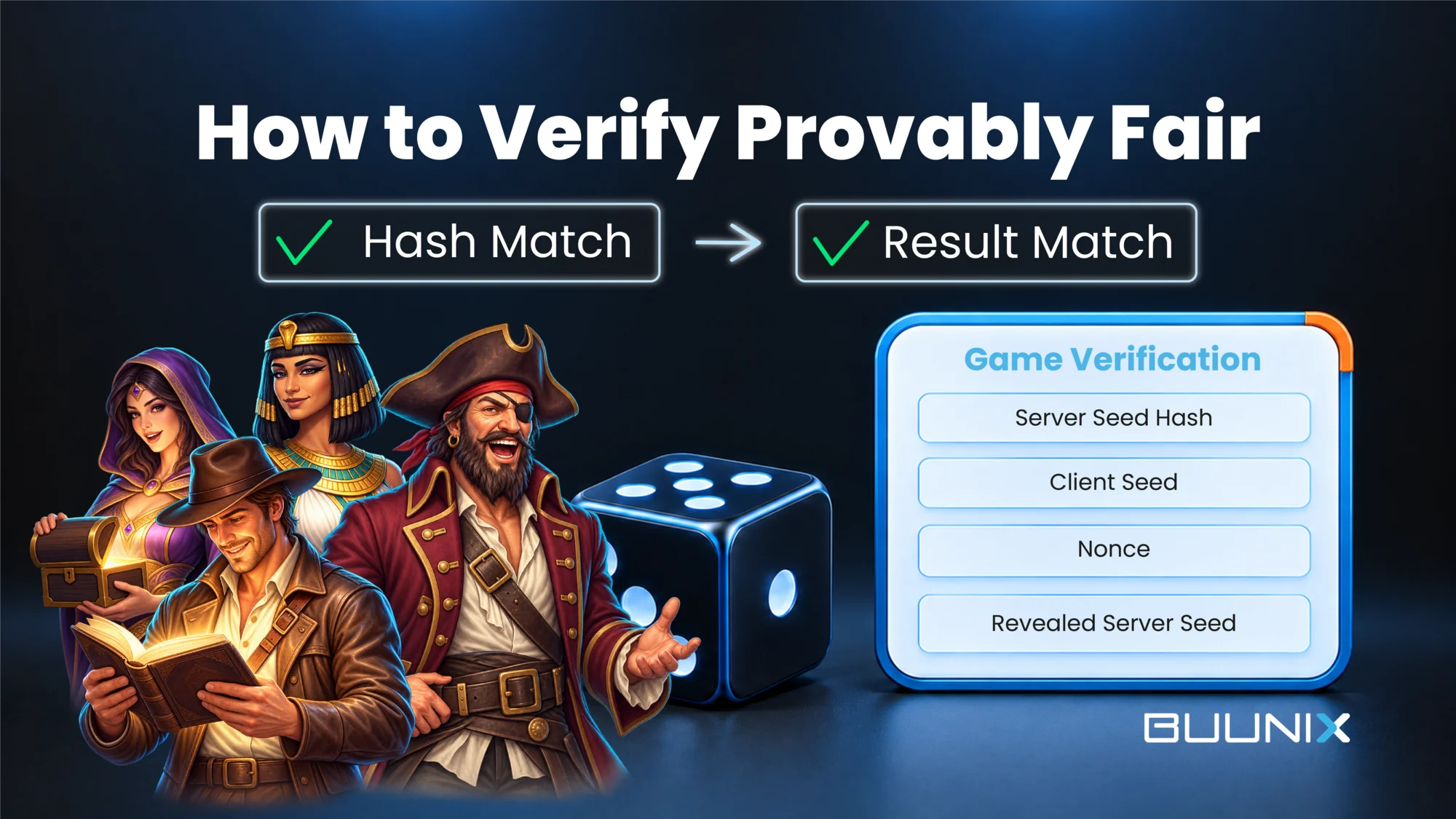
Provably fair technology is useful only if you know how to check it.
A casino can display a “Provably Fair” badge, show a long SHA-256 hash, and still leave most players wondering what they are supposed to do with it. Fortunately, provably fair verification is much less complicated once you separate it into two checks.
First, you confirm that the casino revealed the same server seed it committed to before you played. Second, you reproduce the completed game result using the seeds, nonce, and the game’s documented algorithm.
This guide explains how to verify provably fair casino games step by step — and, just as importantly, what a successful verification does and does not prove.
What Do You Need to Verify a Provably Fair Game?
To verify a provably fair game, you normally need the server seed hash, revealed server seed, client seed, nonce, and the casino’s game-specific calculation method. Without the correct inputs, an independent verifier cannot reproduce the round reliably.
Before starting, collect the following information:
| Data | What It Does | Where You May Find It |
|---|---|---|
| Server seed hash | Records the casino’s pre-game commitment | Fairness or seed settings |
| Revealed server seed | Lets you check the original commitment | Seed history after rotation |
| Client seed | Adds a player-side input | Fairness settings or bet details |
| Nonce | Identifies a particular bet within the seed sequence | Bet history or verifier |
| Game settings | Defines variables such as mines, rows, or risk level | Individual bet details |
| Result | Gives you the outcome to reproduce | Bet history |
Names and locations vary by platform. Some casinos display all values in a dedicated fairness panel, while others attach them to individual bets.
Most importantly, don’t confuse the server seed hash with the actual server seed. The first is a cryptographic commitment. The second remains hidden while the seed is active and is revealed later.
How to Verify Provably Fair Results in 5 Steps
To verify a completed provably fair round, save its original server-seed hash and round data, obtain the revealed server seed, confirm that its hash matches the original commitment, and then reproduce the game outcome using the casino’s documented algorithm.
Here is the process from beginning to end.
Step 1: Save the Server Seed Hash Before You Play
Before placing a bet, locate the game’s fairness settings and find the hashed server seed.
Copy it somewhere or take a screenshot.
Why do this before playing?
The casino initially keeps the raw server seed secret but publishes its cryptographic hash. That creates a commitment to a specific seed without revealing the seed itself.
After the casino eventually reveals the raw value, you can hash it again. If the result matches the hash you saved earlier, you have evidence that the underlying server seed did not change.
NIST’s documentation on hash functions explains that algorithms such as SHA-256 map input data to fixed-length message digests. Changing the underlying input changes the resulting digest.
Without the original hash, you may still reproduce an outcome later, but you lose an important piece of evidence: proof that the casino committed to that server seed in advance.
Step 2: Record the Client Seed, Nonce, and Bet Details
Next, record the information associated with the round you want to audit.
At minimum, keep:
- Client seed
- Nonce
- Bet or round ID
- Game type
- Final result
For some games, you’ll need additional parameters. Mines may require the number of mines. Plinko may require rows and risk settings. Card games can use their own deck-generation or shuffle rules.
The nonce is particularly easy to overlook. It usually acts as a counter, allowing multiple unique results to be produced using the same seed pair.
If you try to verify bet #42 using the nonce from bet #41, your calculation can produce a perfectly valid-looking but completely different result.
Step 3: Reveal or Rotate the Server Seed
You cannot complete the full verification while the active server seed remains secret.
Depending on the casino, you may need to select an option such as Rotate Seed, Change Seed, or Reveal Seed. Other platforms automatically expose previous seeds in their fairness history.
Once revealed, save the raw server seed.
There is an important security rule here: a provably fair verifier should ask only for game-verification data. Never provide a verifier with:
- Wallet seed phrases
- Crypto private keys
- Account passwords
- Two-factor authentication codes
A casino’s “server seed” is part of the fairness mechanism. Your wallet’s recovery seed is an entirely different thing.
How to Check Provably Fair Server Seed Commitments
Once you have the revealed server seed, your first actual cryptographic check is straightforward:
Hash the revealed server seed using the algorithm specified by the casino and compare the result with the server seed hash you recorded before playing.
For a SHA-256 implementation, conceptually:
SHA-256(revealed server seed) → calculated hash
Then compare:
calculated hash = pre-game server seed hash
There are three possible situations:
| Result | What It Means | What to Do |
|---|---|---|
| Exact match | Revealed seed corresponds to the earlier commitment | Continue to result verification |
| Mismatch | Something in the verification does not correspond | Check seed, encoding, whitespace, and seed cycle |
| Original hash unavailable | You cannot establish the original commitment independently | Save it before your next betting session |
An exact match does not yet verify the final casino result.
It only answers the first question: Did the revealed server seed match the value the casino cryptographically committed to earlier?
You still need to verify how that seed produced your result.
Step 4: Reproduce the Cryptographic Output
Now combine the inputs according to the casino’s documented implementation.
Many provably fair systems use HMAC-SHA256, with the server seed and a message constructed from values such as the client seed and nonce.
A simplified implementation might resemble:
HMAC-SHA256(server seed, client seed + nonce)
But don’t copy this formula blindly.
The exact implementation matters. Casinos can use different:
- Key/message ordering
- Separators
- Cursors
- Encodings
- Additional parameters
- Result-conversion formulas
The reference guide from 100RTP.games highlights this distinction: the precise construction has to come from the operator’s documentation or verified source code rather than being assumed from another casino.
This is also why a generic verifier may successfully validate one game’s commitment while failing to reproduce another game’s final result.
Step 5: Compare the Calculated Result With Your Bet
The cryptographic output still has to be converted into something meaningful to the game.
For example, it could determine:
- A dice roll
- Crash multiplier
- Mine locations
- Plinko path
- Card order
- Roulette result
There is no universal conversion formula for every provably fair casino game.
A dice implementation might convert generated bytes into a number within a defined range. Mines might use them to create a deterministic board shuffle. Crash requires a formula that converts cryptographic output into a multiplier.
Your independently calculated result should ultimately match the result recorded in your bet history.
If it does, you’ve completed both layers of verification:
- Commitment verification: the revealed server seed matches the earlier hash.
- Result verification: the recorded game outcome can be reproduced from the disclosed inputs and documented algorithm.
How to Use a Provably Fair Verifier
A provably fair verifier automates some or all of the calculations above.
Instead of manually calculating SHA-256 and HMAC outputs, you enter the relevant round data into the tool.
A typical verifier asks for:
- Revealed server seed
- Original server seed hash
- Client seed
- Nonce
- Sometimes the game or algorithm
It then recalculates the relevant values and reports whether they match.
An open-source verifier can provide an additional advantage: its implementation can be inspected independently. For example, the open-source Provably Fair Verifier on GitHub performs its calculations client-side using the browser’s Web Crypto API.
However, a verifier is only as useful as the algorithm it implements.
If Casino A calculates Mines positions differently from Casino B, selecting a generic Mines algorithm can return a mismatch even when your seeds are correct.
Why Does Provably Fair Verification Sometimes Fail?
A mismatch doesn’t automatically prove manipulation.
Several mundane errors can produce a completely different output.
| Common Problem | What Happens | What to Check |
|---|---|---|
| Wrong nonce | Different round is reproduced | Exact bet ID and nonce |
| Wrong seed cycle | Hash or result differs | Seed history |
| Extra spaces | Hash changes | Copied seed formatting |
| Text vs. hex encoding | Cryptographic output differs | Casino documentation |
| Wrong parameter order | HMAC differs | Published algorithm |
| Wrong game formula | Hash may match, game result doesn’t | Game-specific calculation |
| Incorrect rounding | Raw result matches but displayed number differs | Precision rules |
This distinction can save you from jumping to the wrong conclusion.
Suppose your server seed passes the commitment check, but your calculated Crash multiplier doesn’t match. The problem could be the multiplier formula rather than the seed itself.
Recheck each stage separately instead of treating verification as one black-box “pass/fail” test.
How Verification Differs Between Casino Games
The initial commitment process can be similar across games. The final result calculation often isn’t.
Dice
Dice is relatively straightforward to audit because the cryptographic output ultimately needs to become a number within a defined range.
That makes it a useful game for learning how to check provably fair systems for the first time.
Crash
Crash games need an additional conversion step that turns cryptographic output into a multiplier.
Different implementations can apply different edge factors, rounding rules, or instant-crash conditions. Use the casino’s own published formula rather than assuming every Crash game operates identically.
Mines
A Mines verifier may need to reconstruct an entire board.
That can involve a deterministic shuffle generated from a cryptographic byte stream. The number of mines and the precise shuffle implementation therefore matter.
Blackjack and Other Card Games
Card games are more complex because the cryptographic output may determine an ordered deck rather than one number.
To verify a provably fair game such as blackjack, the verifier must reproduce the same shuffle or card-selection method used by the casino.
What Does Successful Verification Actually Prove?
A successful check proves something specific, not everything about a casino.
| Successful Check | What You Can Conclude | What You Cannot Conclude |
|---|---|---|
| Seed hash matches | Revealed seed corresponds to the earlier commitment | Casino is trustworthy overall |
| Cryptographic output matches | Same inputs reproduce the expected digest | Payout rules are favorable |
| Final game result matches | Tested round follows the disclosed calculation | Future rounds can be predicted |
This distinction matters.
Provably fair verification is not an RTP test. A casino can generate every result correctly and still build a mathematical house edge into its payouts.
It also doesn’t verify withdrawal policies, licensing, bonus terms, account security, or customer support.
Think of provable fairness as an audit of how a particular game outcome was generated, not a certificate covering the entire casino.
Can You Verify a Game Before Playing?
You can save the pre-game commitment before playing, but full verification generally happens afterward.
That’s intentional.
The active server seed needs to remain secret. If players could obtain all inputs required to calculate future outcomes, the system could become predictable.
This is why “provably fair” should not be confused with “predictable.”
The server seed hash lets you verify that a commitment exists without revealing the secret itself. Once the seed is retired and revealed, you can audit previous rounds.
In other words:
Provably fair lets you verify the past. It isn’t supposed to reveal the future.
What Should You Do If a Result Doesn’t Match?
First, preserve the original data. Don’t rotate additional seeds or overwrite information before recording what happened.
Then:
- Confirm the server seed, client seed, and nonce belong to the same round.
- Recalculate the server seed hash separately.
- Check the casino’s documentation for its exact algorithm.
- Verify encoding, separators, cursor values, and game settings.
- Try an independent implementation where possible.
- Save the bet ID and both expected and calculated outputs.
- Contact the operator if the discrepancy remains.
If everything is correct and the result still cannot be reproduced, you have a reason to investigate further. A persistent mismatch could come from incorrect documentation, an implementation problem, or another integrity issue; the mismatch alone doesn’t tell you which one.
Quick Provably Fair Verification Checklist
Before considering a round verified, make sure you can answer yes to all of these:
- Did I save or obtain the original server seed hash?
- Do I have the correct revealed server seed?
- Do I have the client seed?
- Do I have the exact nonce for this bet?
- Do I know the casino’s actual algorithm?
- Did the revealed seed reproduce the original hash?
- Did I use the correct game-specific conversion?
- Does my independently calculated result match my bet history?
If the answer to the last two questions is no, the verification isn’t complete yet.
Verify, Don’t Just Trust the Label
Knowing how to verify provably fair games turns a technical-sounding casino feature into something practical.
The strongest verification has two parts: confirm that the revealed server seed matches the commitment recorded before play, then independently reproduce the completed result using the correct round data and game algorithm.
If a casino claims its games are provably fair but doesn’t provide enough information to perform those checks, the claim offers considerably less transparency.