
What Is RTP in Casino Games? Return to Player Explained
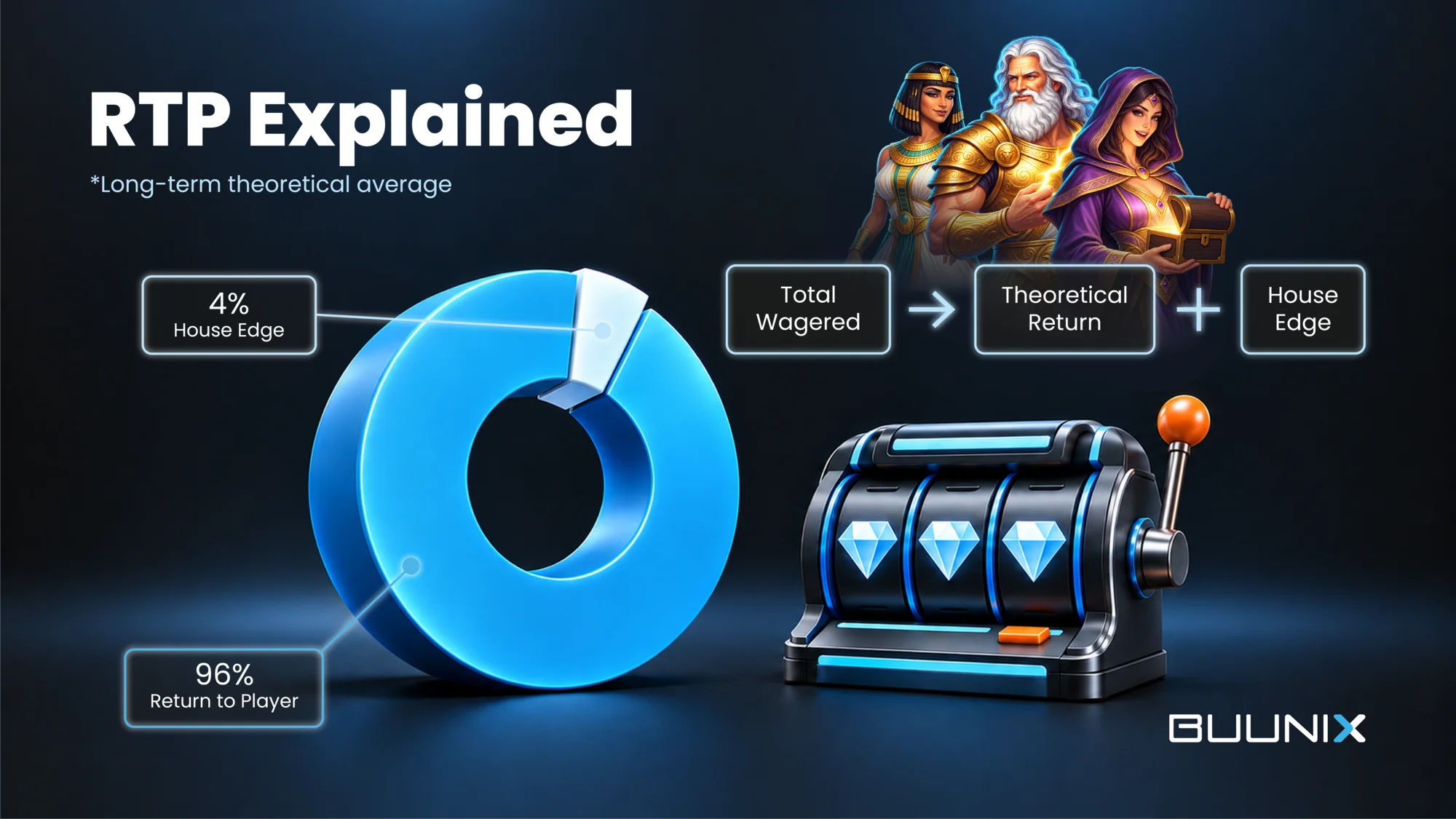
RTP, or Return to Player, is the theoretical percentage of wagered money a casino game is designed to return to players over the long term. A slot with a 96% RTP, for example, has a theoretical return of $96 for every $100 wagered across a very large number of spins.
That does not mean you’ll get $96 back after betting $100 yourself. You could finish with more, less, or nothing at all.
Understanding this distinction is the key to understanding RTP in gambling. RTP is useful for comparing the mathematical characteristics of casino games, but it isn’t a prediction of your next session.
What Does RTP Mean in Gambling?
RTP means Return to Player: the percentage of total wagers a casino game is mathematically designed to return to players over the long run. The remaining percentage represents the game’s theoretical house edge.
The relationship is simple:
House Edge = 100% − RTP
For example:
| RTP | Theoretical House Edge | Long-Term Theoretical Return per $100 Wagered |
|---|---|---|
| 92% | 8% | $92 |
| 94% | 6% | $94 |
| 96% | 4% | $96 |
| 97% | 3% | $97 |
| 98% | 2% | $98 |
So, what does RTP mean in gambling from a practical perspective?
If two otherwise comparable games have RTPs of 94% and 97%, the 97% game has a lower mathematical house advantage. That difference becomes meaningful across large amounts of wagering.
However, RTP describes an expected long-term return, not what happens to one player’s $100 deposit.
How Does RTP Work?
Casino games have mathematical models defining possible outcomes, their probabilities, and their payouts. RTP summarizes the expected return produced by that model as a percentage.
At its simplest, actual return can be expressed as:
RTP (%) = Total Amount Paid to Players ÷ Total Amount Wagered × 100
Suppose players collectively wager $1,000,000 and receive $960,000 in payouts. The observed return would be:
$960,000 ÷ $1,000,000 × 100 = 96%
But published casino RTP is generally a theoretical RTP, calculated from the game’s mathematical model rather than from one player’s actual session.
This difference gives us two useful concepts:
| Metric | What It Measures |
|---|---|
| Theoretical RTP | The return predicted by the game’s underlying mathematics over a very large sample |
| Actual RTP | What a game actually returned during a specific observed sample |
Actual RTP can fluctuate significantly over smaller samples. As more game rounds accumulate, observed results may move closer to the theoretical expectation — but there is no requirement for an individual session to do so.
What Does RTP Mean in Slots?
The RTP slots meaning is the same basic concept: the percentage of all wagers that a slot’s mathematical model is expected to return over the long term.
Suppose an online slot has an RTP of 96%. This does not mean: bet $100 and receive $96 back.
Instead, imagine a very large pool of wagers across many players and spins. For every $1,000,000 wagered, the mathematical model would theoretically return around $960,000 and retain approximately $40,000 as house edge.
The 96% is therefore a property of the game’s mathematics — not a promise made to each player.
This distinction is also emphasized in NJ.com’s RTP guide: personal results can be dramatically higher or lower than the published RTP because the percentage describes long-term mathematical behavior rather than an individual session.
Why Online Slots RTP Needs a Large Sample
A slot can have thousands or millions of possible outcome combinations. Some outcomes may happen frequently and pay little; others may be extremely rare and pay thousands of times the original bet.
That creates variance.
Imagine a hypothetical 96% RTP slot with a maximum win of 10,000×. If you play only 100 spins and don’t hit any rare high-paying combinations, your personal return could be far below 96%.
Another player could hit a huge win almost immediately and record an actual return far above 100%. Neither result changes the slot’s theoretical RTP.
What Is a Good RTP for Slots?
An RTP of around 96% is a common benchmark for online slots, while 97% or higher can generally be considered a high RTP when comparing similar games. However, there is no universal percentage that automatically makes a slot “good.”
A practical comparison looks like this:
| Slot RTP | General Interpretation | House Edge |
|---|---|---|
| Below 94% | Relatively low RTP | Above 6% |
| 94–95.99% | Moderate | 4.01–6% |
| 96–96.99% | Competitive | 3.01–4% |
| 97%+ | High RTP | Below 3% |
These ranges are guidelines rather than regulatory categories.
Racing Post, for example, treats roughly 96–98% as a favorable range and describes 97%+ games as high-RTP slots.
So when asking what is a good RTP for slots, the more useful question is: how does this RTP compare with other versions and games I’m considering?
A 97% slot has better theoretical long-term value than an otherwise identical 94% slot. That does not mean it will pay more during your next 50 spins.
RTP vs. Volatility: What’s the Difference?
RTP tells you how much a game is mathematically expected to return over time. Volatility tells you more about how those returns may be distributed. They should not be treated as interchangeable.
Consider two hypothetical RTP slots, both set at 96%.
Slot A — lower volatility: returns are distributed across more frequent, generally smaller wins.
Slot B — higher volatility: returns are concentrated into less frequent but potentially much larger wins.
Both can theoretically reach the same 96% RTP over a sufficiently large sample while producing very different playing experiences.
| Metric | Question It Answers |
|---|---|
| RTP | What proportion of wagers is theoretically returned long term? |
| House edge | What proportion is theoretically retained by the house? |
| Volatility | How variable are the payouts? |
| Hit frequency | How often does a spin produce a winning result? |
| Maximum win | How large can a game’s top payout be? |
This is why selecting a game based only on slot RTP meaning gives you an incomplete picture. A high-RTP, high-volatility slot can still produce long losing sequences.
RTP vs. Hit Frequency
Hit frequency is another metric players often confuse with RTP. Hit frequency measures how often a game produces a winning outcome. RTP measures the value of payouts relative to wagers over the long run.
Imagine two hypothetical slots:
| Slot A | Slot B | |
|---|---|---|
| RTP | 96% | 96% |
| Hit Frequency | 35% | 20% |
| Typical Pattern | More frequent smaller wins | Fewer, potentially larger wins |
The RTP is identical. The distribution isn’t.
A game can therefore have a high hit frequency without having a particularly high RTP. Many of its “wins” could even be smaller than the original stake.
If you wager $1 and receive $0.50, the spin may technically record a payout, but your bankroll still fell by $0.50.
Does Higher RTP Mean Better Chances of Winning?
Not necessarily — and this is one of the most important RTP misconceptions.
Higher RTP means a lower theoretical house edge. It does not necessarily mean a higher probability of winning an individual spin or session.
Consider two hypothetical games:
- Game A: 97% RTP, high volatility
- Game B: 95% RTP, low volatility
Game A has the better theoretical long-term return. Game B could still produce winning outcomes more frequently.
RTP doesn’t tell you when payouts happen, how large they are, or whether your next session will be profitable. It only tells you the expected proportion of wagers returned over the long run.
Why a 96% RTP Doesn’t Mean You Lose Only $4 From $100
This misunderstanding deserves its own example.
Suppose you deposit $100 and make 100 spins at $1 each on a 96% RTP slot. It is incorrect to assume that $100 wagered minus 4% leaves a $96 final balance.
You might finish with:
- $0
- $38
- $96
- $140
- $1,000+
The RTP does not constrain your individual result to $96.
There’s another important detail: money deposited is not the same as money wagered. Suppose you deposit $100, win and reuse some of those winnings, eventually making $500 in total wagers during the session. RTP applies conceptually to the $500 wagered, not your original $100 deposit.
That distinction is easy to miss when reading statements such as “96% RTP returns $96 per $100.”
High RTP Online Slots vs. Low RTP Slots
When everything else is equal, high RTP online slots offer a lower mathematical house edge. Here’s how seemingly small differences accumulate theoretically. Imagine $10,000 in total wagering:
| RTP | Theoretical Return | Theoretical House Edge |
|---|---|---|
| 92% | $9,200 | $800 |
| 94% | $9,400 | $600 |
| 96% | $9,600 | $400 |
| 98% | $9,800 | $200 |
The difference between 94% and 98% RTP is only four percentage points. Across $10,000 wagered, however, that corresponds to a $400 difference in theoretical return.
Again, these are expected values, not guaranteed outcomes. A player could still win substantially on a 92% game and lose heavily on a 98% game during a short session.
Can the Same Slot Have Different RTPs?
Yes. This is one of the more useful things to check before playing.
Some game providers can offer multiple RTP configurations of the same slot. That means seeing the same game title at two casinos doesn’t necessarily guarantee identical mathematical settings.
NJ.com’s guide specifically notes that RTP can vary between casino versions of the same game.
For example, a hypothetical slot might be available to operators in several configurations:
- 96.5%
- 95%
- 94%
- 92%
The graphics, symbols, and bonus mechanics could look almost identical while the theoretical return differs. This makes the RTP displayed inside the actual game version you’re playing more useful than an RTP copied from an old review or another casino.
How to Find the RTP of an Online Slot
For most online slots, RTP information can be found inside the game’s information interface. Before playing, check:
- Game information or Help — often accessible through an “i,” menu, or settings icon.
- Paytable — some developers include RTP alongside payout information.
- Game rules — RTP and volatility may appear in the technical details.
- Provider documentation — useful for confirming available versions.
- Casino game information — some operators display RTP directly in their libraries.
Racing Post similarly recommends checking the game’s information/paytable or provider documentation when looking for the applicable percentage. If different websites report different percentages, prioritize the information associated with the specific version currently loaded at the casino.
Does RTP Work Differently in Provably Fair Crypto Games?
Not fundamentally. RTP and provable fairness answer two separate questions. RTP asks: what is the game’s expected mathematical return? Provably fair technology asks: can I verify that the game outcome was generated according to predetermined cryptographic inputs?
A crypto casino game could theoretically have:
- 99% RTP and be provably fair;
- 94% RTP and be provably fair;
- 96% RTP and use a conventional audited RNG.
Provable fairness doesn’t automatically create a high RTP. Likewise, a high RTP doesn’t prove that individual results were generated fairly. Want to go deeper? Learn how provably fair gaming works and how crypto casino outcomes can be independently verified.
Common RTP Myths Explained
Knowing what RTP means also means knowing what it cannot tell you.
“A 96% RTP Slot Owes Me 96% Back”
No. The percentage is not calculated separately for each player or session.
“A Slot Hasn’t Paid Recently, So a Win Is Due”
No. With properly implemented RNG-based slots, individual spins are independent. A losing streak doesn’t force the next spin to become a winner.
“The Highest RTP Slot Will Pay Me More Today”
Not necessarily. Higher RTP improves theoretical long-term value, not short-term certainty.
“RTP and Volatility Are the Same Thing”
No. RTP measures expected return; volatility describes the distribution and variability of payouts.
“RTP Tells Me How Often I’ll Win”
No. That’s closer to hit frequency. A game can pay frequently but still have a lower RTP if many payouts are small.
What Should You Check Besides RTP?
RTP is useful, but don’t evaluate a casino game using one percentage alone. For slots in particular, consider:
- RTP
- Volatility
- Hit frequency, when disclosed
- Maximum win
- Paytable
- Bonus mechanics
- Jackpot contribution
- Game rules
For crypto casino games, you can also check whether the game offers a transparent provably fair verification mechanism. Together, these characteristics tell you much more than RTP alone.
The Bottom Line on RTP
If you’ve wondered what does RTP mean, the simplest answer is this: RTP describes how much of all money wagered a casino game’s mathematical model is designed to return over the long run.
A higher RTP means a lower theoretical house edge. But it doesn’t tell you what you’ll win tonight, when a slot will pay, or how frequently winning spins will occur.
The most useful approach is therefore comparative. Check the RTP of the exact game version you’re considering, then look at volatility, hit frequency, rules, and other mechanics before deciding whether the game suits you.